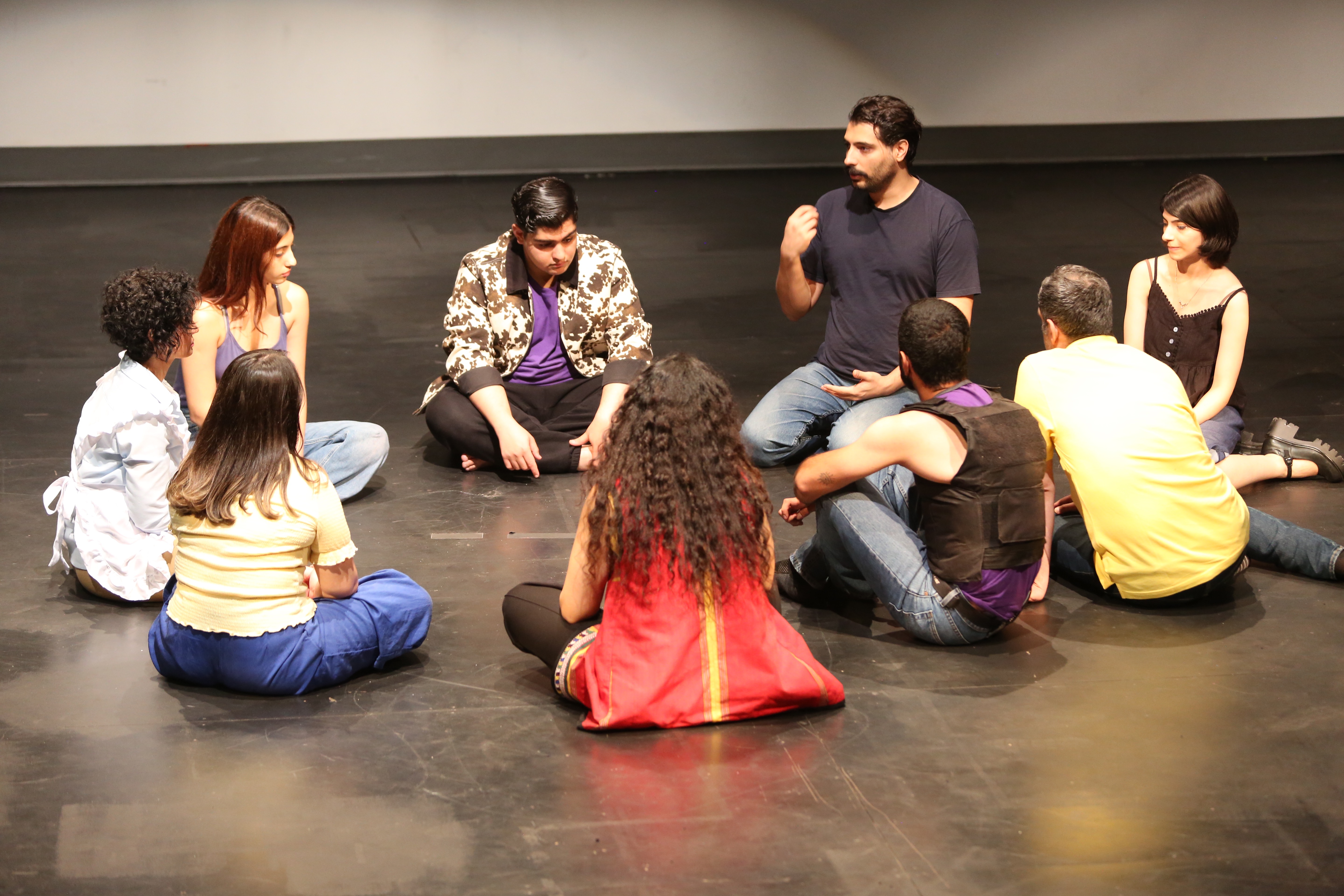
Notes on how a friendship, and a short story became a stage work.
How it began (2019)
The Destroyed started as a conversation between friends. In a master’s theory seminar, my colleague Sadegh Roshan presented Jacques Rancière’s The Emancipated Spectator with the kind of passion that makes a room sit up. I’d read the essay before, but that day it felt newly urgent: what if a performance doesn’t ask the audience to decode a message, but invites them to co-author meaning?
Around the same time, Sadegh introduced me to a short story by Aboutorab Khosravi, spare, unsettling, and resolutely undramatic in the conventional sense. In another course, Dramatic Aspects of Persian Literature, we were being asked to “find” drama where it didn’t exist. Khosravi’s story resisted that assignment beautifully. So we asked a different question: How do you stage a text that refuses to be staged?
We gathered a small ensemble, Kiarash Dadgar, Amin Simiar, Parham, Arvan, and others, and began rehearsals. Two months in, the world stopped. COVID arrived, then the distance, and the project went quiet. I turned to solo work, but The Destroyed stayed with me like a seed waiting for the season to change.
Reimagining in Montréal
When I moved to Montréal, the seed sprouted. In April 2025 I started sketching scenes and asking how technology and non-theatre collaborators might expand the piece. What if the stage welcomed people whose expertise wasn’t theatre but whose lived experience, technical fluency, and cultural memory were exactly what the work needed?
I reached out, a producer came on board, and suddenly the ecology of the project changed. We needed a stage manager, then more performers, designers, and technical leads. The team grew—fifteen, then sixteen, each person filling a space we hadn’t known was empty until they stepped into it.
Form & language
The Destroyed is polyphonic by design. It speaks English, French, and Persian, and at points Kurdish. Its gestures are drawn from Iranian ritual forms and performative storytelling including naqqāli (epic narration) with threads from the south and the western borders of Iran. The result isn’t folkloric quotation; it’s a living syntax where ritual, image, and testimony circulate to generate meaning with the audience rather than for them.
Even off the page, Khosravi’s refusal to “perform drama” remains the spine of the piece. We don’t adapt the story so much as stage its resistance building a score of images, actions, and invitations that let spectators assemble their own narrative pathways.
Process
- Ensemble-led dramaturgy. Scenes are built from prompts, interviews, and shared archives. We keep the rehearsal room hospitable to experiment and contradiction.
- Technology as partner. Cameras and projections shape attention rather than decorate it
- Access to performance. Many collaborators do not have formal theatre backgrounds. That is deliberate. For us, the ability to perform is a right, not a credential.
Where it is now
We mounted a three-night tryout in Montréal to gather feedback and refine the score. The response confirmed what we felt in the room: the piece resonates across languages and geographies while staying unmistakably Iranian in its ethics, humor, and wounds. We’re now polishing the work and planning presentations with larger audiences and venues.
Gratitude
To Sadegh for the spark; to the early ensemble for the courage to begin; to the current team for building a world together; and to the audiences who met us halfway and made their own stories out of ours.
Fortunately, the piece was succesful in driving media attention which I have listed the links below
Radio:
McGill: Upstage Radio Show
Concordia University: Voice of the Voiceless
UQAM: État de flow
TV:
Web:
If you’re interested in presenting The Destroyed or collaborating on its next iteration, I’d love to talk.
Credits
Producers: Shadi Yazdani, Syd Hamidreza Hosseini
Director: Syd Hamidreza Hosseini
Dramaturg: Shahab Nezamdoost
Video Art: Rebecca Acone
Sound design: Kamyar Karimi
Performers: Saina Alikhani, Pani Bolbolabadi, Nastaran Pourtaherian, Amir Pakdel, Parsa Sahidian, Shadi Yazdani
Photographer: Masoud Pakdel
Stage Manager: Hamed Sadatbarikani
Videographer: Krystian Erlindo Sosa
Graphic Designer: Amirhossein Zarifian
Assistant Director: Mina Bahra
Media relations Manager: Raphaëlle Behar